


By D’Arcy Morrell –
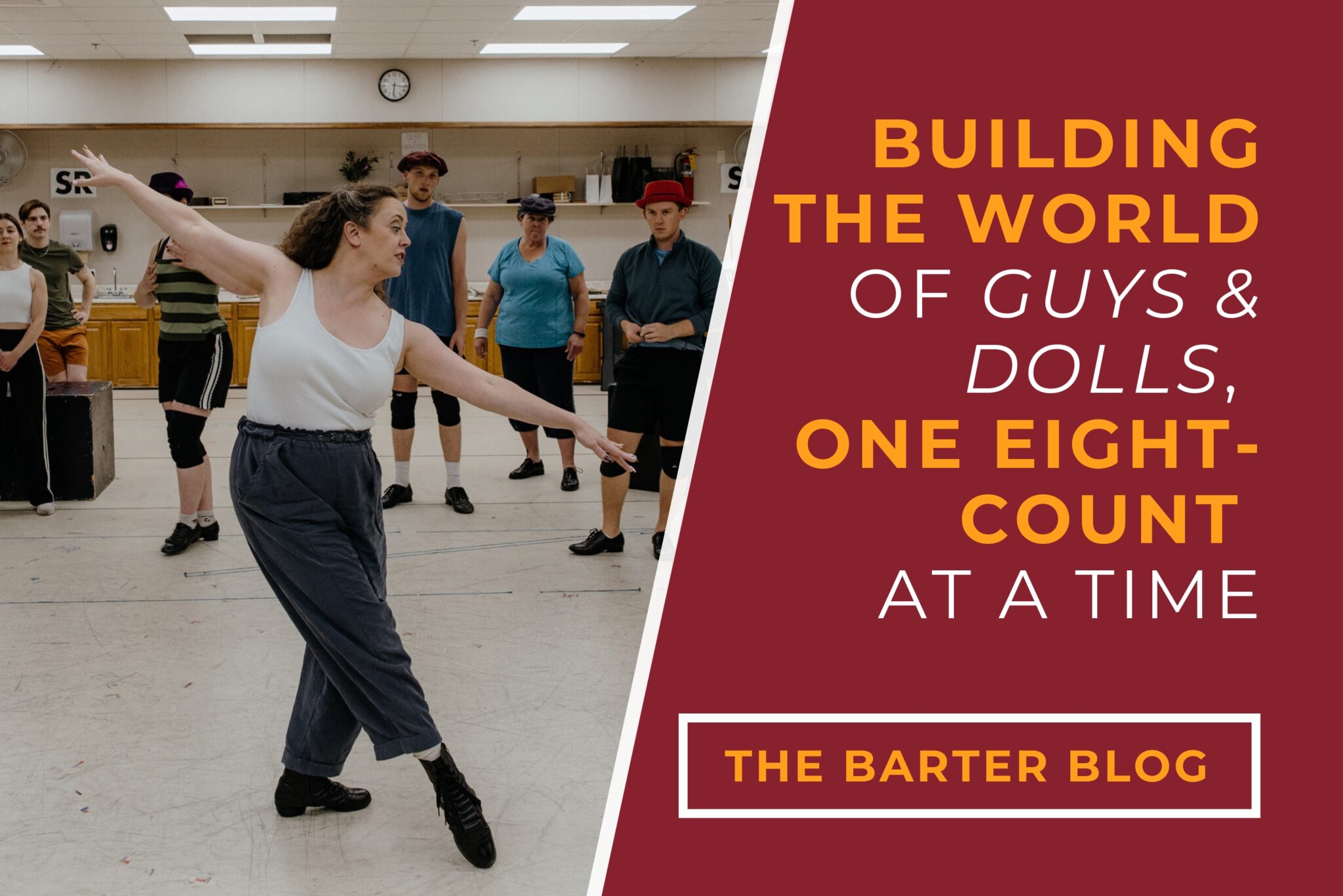
There are few musicals as instantly recognizable as Guys & Dolls. From the bustling streets of New York to the glittering Hot Box and the iconic Crapshooter’s Dance, its choreography has helped define the show for generations of audiences. So when Barter Theatre began work on its own production, choreographer and longtime Resident Company Member Ashley Campos wasn’t just weaving together steps; she was asking a much bigger question: How do we tell this story through movement?
Long before the cast begins learning any dance combinations or travel patterns, Campos is already living inside the fast-paced world of gamblers and the women that steal their hearts. “The first thing I do with any musical is listen [to the score] from start to finish over and over and over again,” Campos said. “Starting several months out from first rehearsal, I listen in the car, mowing the lawn, folding laundry; any task that keeps my body busy so I can start to imagine the overall dance map and journey of the show without getting bogged down in specific choreography.”
“The next (and most important) step is meeting with the director [Sarah Van Deusen] to understand [her] vision for the show and how I can best support it through movement.” Those conversations aren’t about choreography as much as they are about storytelling. Together, Campos and Van Deusen ask the questions that shape the production from the inside out. What kind of club is the Hot Box? Are Adelaide and the dancers presenting an elegant floor show or something a little less refined? How does Sarah Brown and Sky Masterson’s relationship evolve in Havana with very little dialogue? What story should the audience experience during the Crapshooter’s Dance? Who wins? Who loses? Only once those questions are answered does choreography begin to take shape.
Campos then returns to the music, listening to each number repeatedly before putting pencil to paper. “I’ll again listen to each number on repeat and envision the overall progression… and once I’m happy with the big picture, I start the nitty-gritty process of notating actual dance steps and stage pictures.” From there, musical counts, shorthand, sketches, and stage diagrams fill pages of notes as she carefully maps formations, entrances, and exits. It’s meticulous work and, as Campos puts it, the most time-intensive part of her process, involving “dozens of hours in front of my dining room mirror.”
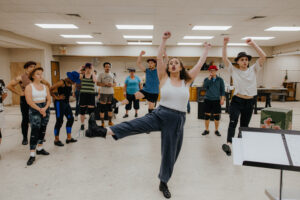
Even then, she knows the work isn’t finished. “I work hard to have a very solid plan in rehearsals,” she said, “but there are often elements like complex movement patterns, partner lifts, etc. that need to be workshopped in the room, and sometimes my plan doesn’t work at all!”
If choreography begins in solitude, it comes to life through collaboration. For Guys & Dolls, Campos relied heavily on dance captains Zacchaeus Kimbrell and Delaney Jackson throughout rehearsals. Zacchaeus, she said, “has an eye for the big picture and is able to flag trouble spots and solve traffic issues,” while Delaney “has an impeccable eye for details and helping adjust things to make them clear, clean, and consistent.” “We can usually find the solution at the time,” Campos said, “but sometimes I need to go back to the drawing board and revisit a section a few days later with a new plan. Flexibility is all a part of the process!”
That collaboration extends far beyond the rehearsal hall. Take the Hot Box number, “Take Back Your Mink,” for instance. From the audience’s perspective, it’s a dazzling sequence of perfectly timed costume reveals. Behind the scenes, every one of those moments required careful coordination between Campos and costume designer Kelly Jenkins.
“…Kelly and I spent lots of time figuring things like, ‘Which hand pulls off the skirt? How do we keep the hats secure until we need them to pop off? Can we make the “minks” strong enough to withstand dancing? How do we keep the pearls from breaking when being removed in one count and thrown on the floor?” Ashley notes that “Kelly is an incredibly experienced collaborator…and together we came up with elegant solutions to all of our obstacles.”
Another of Ashley’s closest collaborators is someone audiences know well: her husband and fellow Resident Company Member Sean Campos, who plays Sky Masterson. “I absolutely love choreographing for Sean; he is my muse and the male dancer in my head when I am dreaming up dances.” It’s a partnership built over twenty-two years of dancing together. While Ashley develops the choreography herself, she turns to Sean when productions call for ballroom dancing or complex partnering. “He is gracious enough to help me figure out tricky passes and coaches the men in lifts and partnering and has excellent tips and tricks in his back pocket to help maintain safety and consistency.”
At the heart of every decision, though, is the score itself. “For me the musicality is everything!” Campos said. “The lyrics are our clearest indicator of the story, but the instrumental support guides the flow.” She studies the contrasts written into Frank Loesser’s music—quiet and bold moments, sharp rhythms and flowing melodies, solos and full ensemble passages—and allows those shifts to shape the choreography. “I usually find if I follow the road map the composers have laid out, it leads to a harmonious and satisfying feeling on stage.”
It’s an instinct built over a lifetime of rigorous dance training. Campos began dancing at three years old and describes herself as “a voracious consumer of dance media.” From years spent in classical ballet to the films of Gene Kelly, Esther Williams, Fred Astaire and Ginger Rogers, to choreographers like Bob Fosse, Jerome Robbins, Alvin Ailey, Martha Graham, and so many more, every influence has helped shape the artist she is today. “I never want to copy what someone is doing,” she said, “but all of these different influences certainly give me a deep and broad well of inspiration for the type of feeling I want to evoke with each different piece.”
When asked to choose a favorite number in Guys & Dolls, Campos couldn’t quite settle on one. The Crapshooter’s Dance, she said, was especially rewarding because it gave her the opportunity to create “an old school story ballet with a huge ensemble.” Storyboarding the rise and fall of an all-night craps game became “an incredibly fun challenge.”
Her other pick, “Sit Down You’re Rockin’ the Boat,” required almost the opposite approach. With twenty performers packed into the Mission, there was little room on stage for sweeping movement. Instead, the energy comes from “rippled patterns, tight focus shifts, and group dynamics,” creating what Campos calls “an absolute show stopper”.
Like every production at Barter, Guys & Dolls is the result of artists working together across departments, each contributing their own expertise in service of a shared story. Campos’ choreography is part of that larger collaboration, weaving together music, character, costume, design, and movement to create a world that feels joyful, dynamic, and alive.
Special Thanks to Abingdon Therapy Services and Spectrum Design for making this production possible. Guys & Dolls is currently playing at Barter’s Gilliam Stage until August 9th.
