


By D’Arcy Morrell –
Step into the rehearsal room for The Three Musketeers and you will find actors standing at measured distances, listening intently as fight choreographer Rod Kinter breaks down a sequence into its smallest components. Each and every move is intentionally choreographed so that the illusion of danger reads clearly while the actor lands safely, predictably, and in control. What appears to be a fast, thrilling duel on stage actually begins with slow, deliberate work behind the scenes.
In Barter Theatre’s production of The Three Musketeers, the fight scenes do more than provide excitement; they help tell the story. As the characters and circumstances evolve, so do the fights. Kinter puts it simply: “When you define stage combat, what is it? It’s physical storytelling.” Each moment of conflict reveals something about the characters involved and what is at stake.
Cathy Bush’s adaptation of the swashbuckling classic follows D’Artagnan, a young man who arrives in Paris dreaming of glory and excitement. At the beginning of the story, the fights reflect that youthful enthusiasm. “We’re seeing the world through the eyes of D’Artagnan,” Kinter says. Early fights feel bold and playful, especially the large street battle and the lively barroom brawl. In these scenes, the action even includes comic touches, like characters drinking or grabbing whatever is nearby to use as a weapon.
As the story unfolds, however, the tone begins to shift. The stakes grow higher, and the consequences become more serious. “As the plot thickens…the world gets darker for D’Artagnan,” Kinter explains. The choreography changes to reflect that new reality. What once was a thrilling adventure evolves into a life-altering quest, where characters are forced to come face to face with who they are and what they’re willing to do. “It doesn’t make sense to continue that sort of playful fun,” he adds, acknowledging that the violence must evolve alongside D’Artagnan’s understanding of the world he inhabits.
Creating these scenes requires careful planning. Kinter prefers to enter rehearsal with a pre-determined idea of how a fight should unfold and what it should communicate. “I like to work with a road map,” he says, drawing on years of experience in both dance and stage combat. Each sequence begins with a basic structure rooted in the scene’s needs. From there, Kinter works closely with the actors and director to refine the timing, pacing, and rhythm of the action. “At the end of the day, I’m creating the director’s vision of the story,” he explains.
Safety guides spacing and timing so the illusion of danger remains convincing without ever putting performers at risk, but safety is only the starting point; what matters just as much is the story behind the movement. Every step must communicate intention. Even small changes in timing, distance, or rhythm can show a shift in emotion or power between characters.
That shift is most evident in the later confrontations. The early fights are broad and playful, built on swagger and spectacle. By contrast, the final duels are intense and more focused, with less emphasis on flourish and more on purpose. D’Artagnan is no longer fighting to prove himself or chase the romance of heroism; he is fighting because something real is on the line.
By the final clash of swords, the audience has witnessed more than a display of skill. They have followed a young man’s transformation told through acts of bravery, honor, and loyalty. What began as a riveting adventure morphs into something steadier and harder won. The story lives not just in the words of the script, but in the movement itself, where carefully crafted combat becomes a powerful form of storytelling.
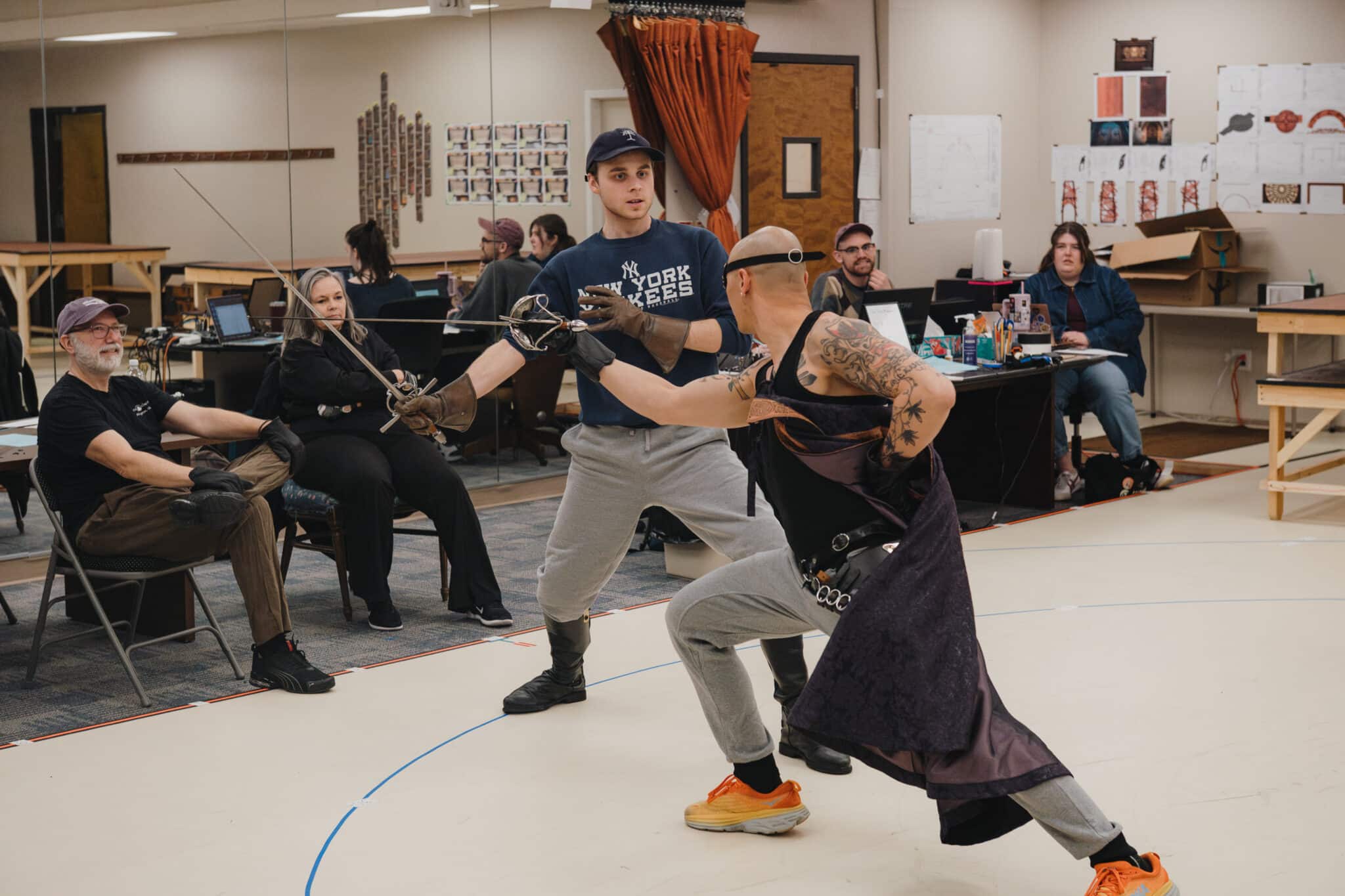
Photographed: Rod Kinter (Fight Choreographer), Barbara Kinter (Assistant Fight Choreographer), Jacob Nuti (D’Artagnan), Sean Maximo Campos (Rochefort), Brady Willis (Assistant Stage Manager), Natasha Carpenter (Production Assistant).
The Three Musketeers is sponsored by Anonymous and E. Dillon & Company.
