

By D’Arcy Morrell –
When Barter Theatre announced that The Da Vinci Code was part of its 2026 Season, the first question on everyone’s mind was, “How are they going to do that?”
The world’s first introduction to the story was Dan Brown’s 2003 bestselling novel, and later the 2006 box office hit starring Tom Hanks. Both mediums—print and film—make it easy, all things considered, to dive into the physical world the story moves through. Staging it live, however, does not. Elements like security footage that serve as puzzle pieces or secret phone calls that connect the dots are significantly more difficult to depict alongside the real-time action happening on stage. Live theatre doesn’t lend itself to the ease of a cutaway shot or an extra paragraph to add context. Every element necessary to telling the story must happen on stage in a way that feels both true to the plot and clear to the audience.
That is where the genius of Barter’s design and production teams comes in. Resident Scenic Designer Derek Smith and The Da Vinci Code Director Nick Piper answered the earlier question with the solution of projecting additional scenes onto the stage during the production. This meant that scenes would need to be filmed in advance and carefully captured to enhance the storytelling, rather than detracting from or diverting attention.
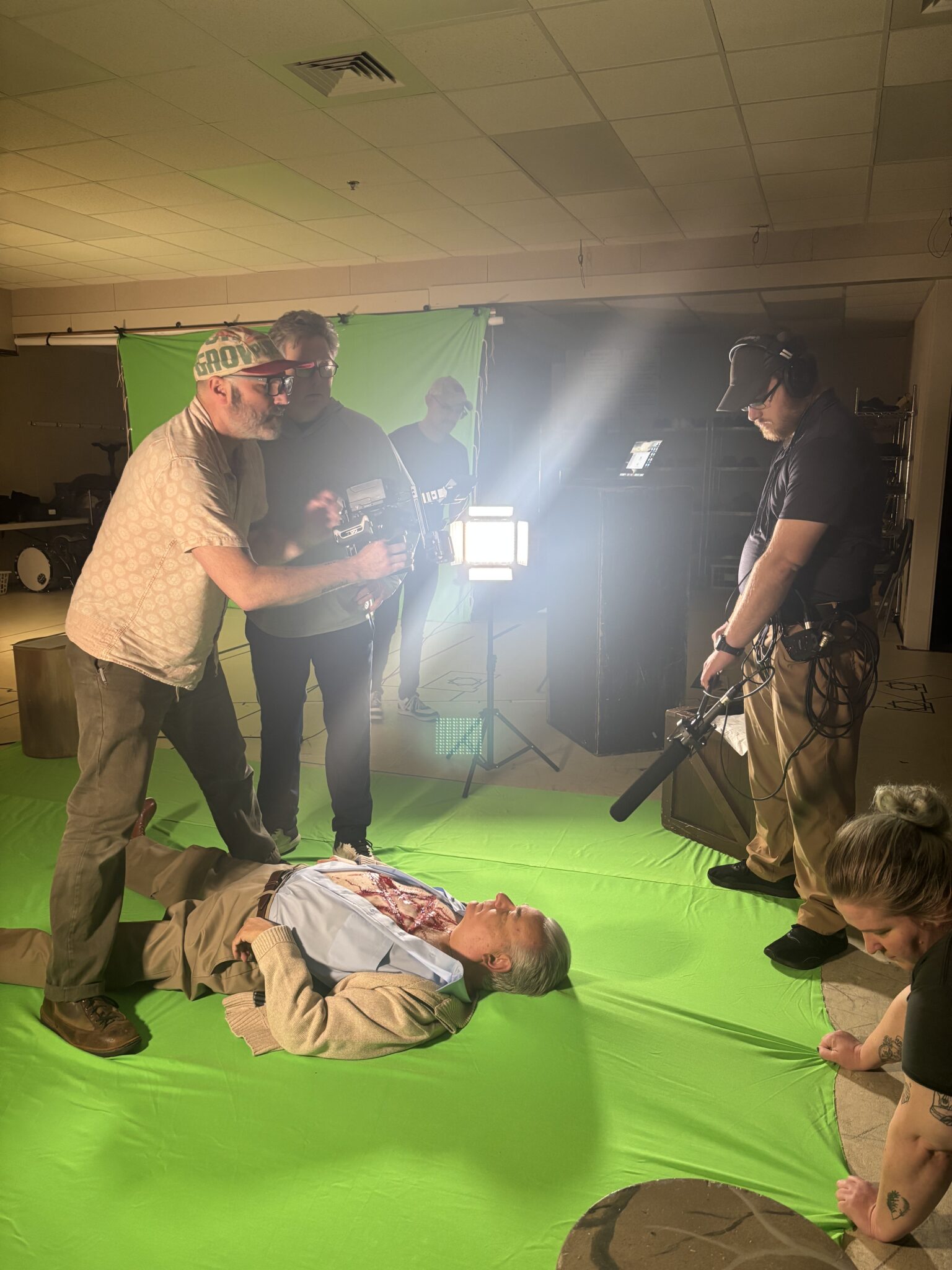
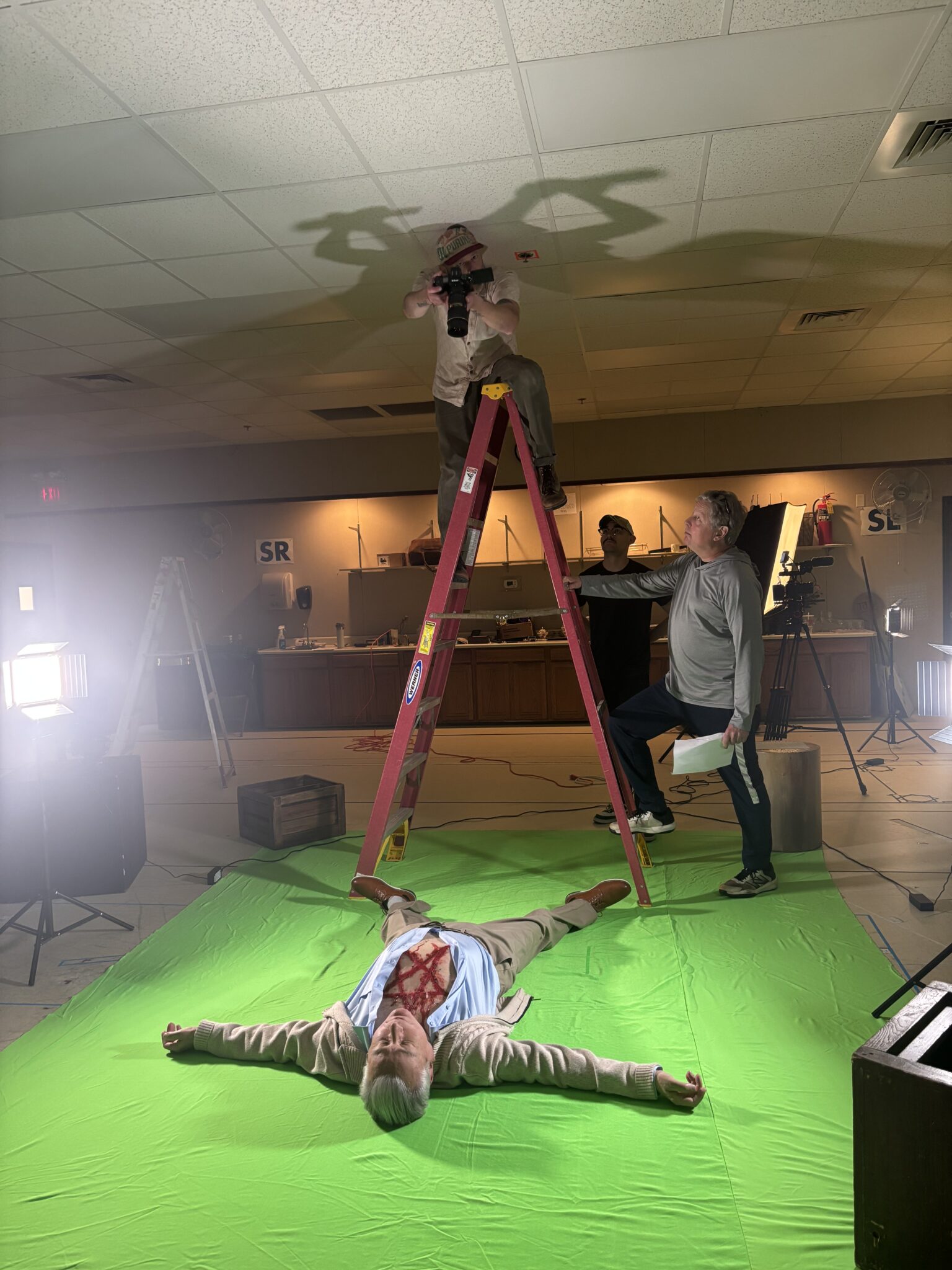
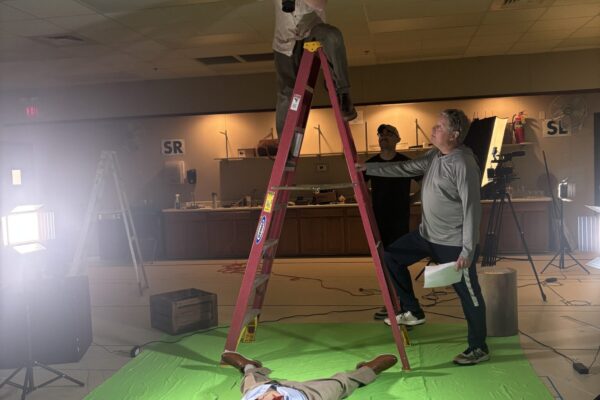
And so they got to work. Armed with a green screen, two cameras, and plenty of fake blood, Smith and Piper, alongside Associate Director of Marketing Scott Little, transformed Tom Celli Rehearsal Hall into a miniature film studio in just three hours.
The team began with simple shots: Louvre Art Museum Curator Jacques Saunière (played by Michael Poisson) writing mysterious messages on the walls; Professor Robert Langdon and Cryptologist Sophie Neveu (played by Sam McCalla and Libby Zabit, respectively) walking through a dark and mysterious Louvre, before moving on to more complex and grueling scenes.
Two of the most gruesome scenes were shot next: Saunière’s death via an engraved pentagram to the chest and Monk Silas’ (played by Jacob Nuti) self-flagellation as a form of religious penance. Both scenes required extensive prosthetic makeup and artificial blood, and thanks to the incredible work of Barter’s costume and makeup artisans, the final products look shockingly real.
One of the most remarkable moments of the day belonged to Jacob Nuti. The scene called for Silas at his most broken, alone with words he can barely bring himself to speak. “Teacher, do you see me? I have failed.” Nuti stepped onto the set and was fully inside the character the minute the cameras started rolling. The monologue built line by line, the despair climbing with each one, until by the final beats, the actor was almost in tears. The performance was so fully realized that only one take was needed, and as soon as the cameras stopped, the room broke into thunderous applause.
That moment said something the technical conversation around it couldn’t. Filming for projection looks, on paper, like a logistical problem—lenses, angles, and render times. What the camera was actually capturing was the same craft the stage will: an actor finding the truth of a scene, and a team around them making sure that truth survives the translation.
Piper directed from the same place he would in a rehearsal, giving clear notes and quickly resetting while having an ear for the story arc inside each beat. Little moved between angles, watching for the light and shadow that would translate cleanly to the projection surface and read well from house seats. Smith stayed close, calling out adjustments only a scenic designer would catch, like the way a reflection would need to fall or the way a shadow would need to land. What looked, on the surface, like three artists doing three separate jobs was, instead, one continuous conversation. Every choice in front of the camera was being weighed against what editing it would need in post-production, where Smith will take the raw footage and shape it into the projected world the audience will see.
When The Da Vinci Code opens on Gilliam Stage, audiences will see a production unlike anything Barter has staged before. They will also see what has brought audiences back to this stage for more than ninety years—the imagination, craft, and conviction of artists who believe that great stories deserve every effort it takes to tell them well. Those are the things no amount of innovation can change, and at Barter, those are the things that matter most.
Special Thanks to Virginia Sports & Chiropractic for making this production possible. The Da Vinci Code is currently playing at Barter’s Gilliam Stage until August 8th.