


By D’Arcy Morrell –
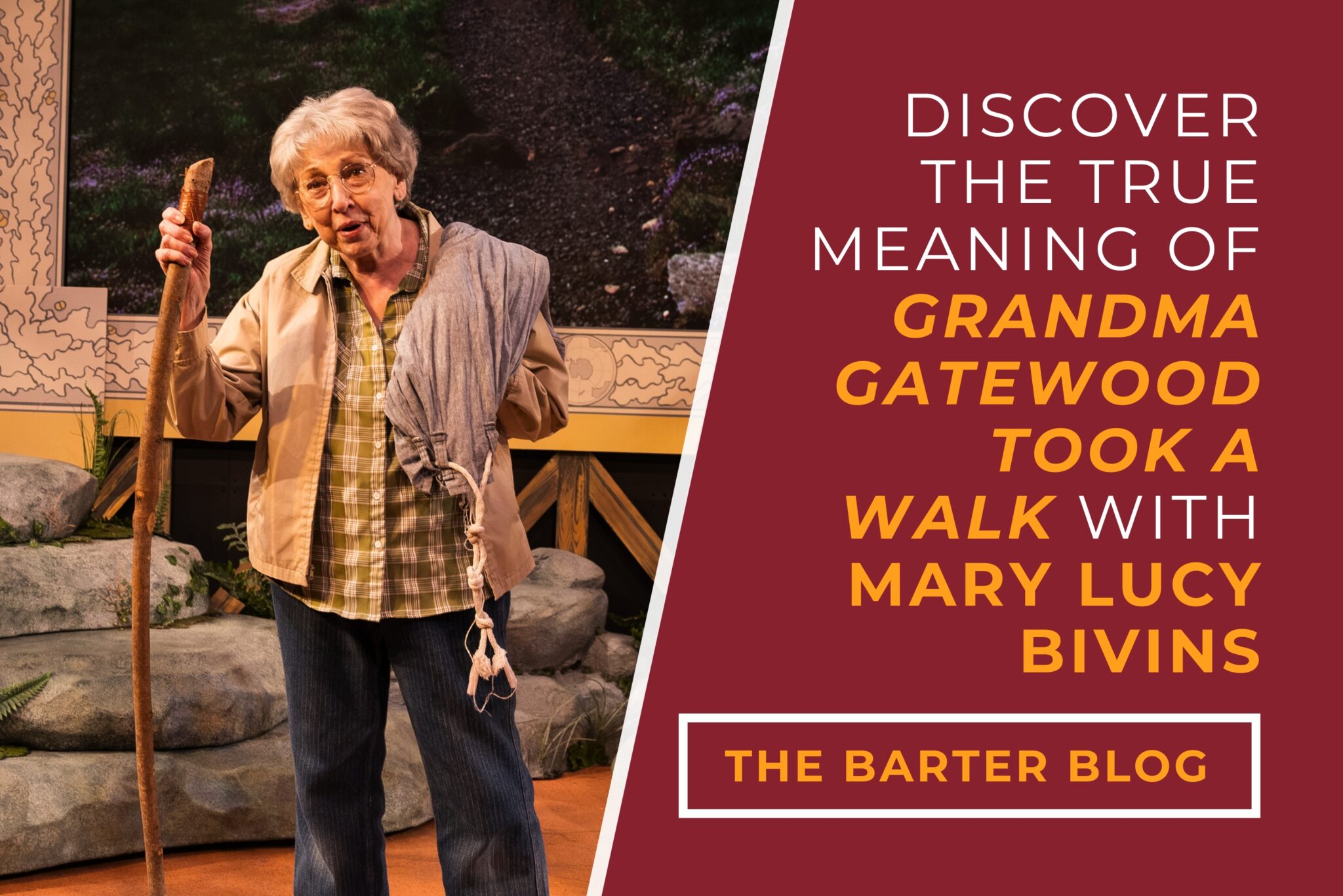
Three years after its world premiere at Barter’s Smith Theatre, Grandma Gatewood Took a Walk continues to draw audiences back for the remarkable true story of Emma “Grandma” Gatewood. In 1955, Gatewood became the first woman to successfully solo thru-hike the entire Appalachian Trail. At 67 years old, it was a feat that forever changed her life and built a lasting legacy that is still remembered today.
At first glance, her story is almost deceptively simple: Woman Breaks Record, but the play quickly reveals that Emma’s journey was never just about the miles she walked. As audiences follow her 146-day trek from Georgia to Maine, they also uncover the painful experiences, resilience, humor, and determination that led her to take that first step.
Dissatisfied with the story life had written for her and yearning for something more, Emma tells her family she’s going for a walk; she neglects to mention that this walk will cover the entire 2,050 miles of the Appalachian Trail. She had attempted this journey once before but found herself unprepared and overwhelmed, ultimately returning home with a damaged but not entirely broken spirit. Tenacious and determined, Emma set out once again and slowly but surely found herself at the summit of a life-changing moment.
On top of Mount Oglethorpe, standing in front of a statue honoring the very man the mountain is named after, Emma noticed three words inscribed: Courage, Industry, and Endurance. It’s in this moment that Emma promises herself that she will succeed this time, come hell or high water, and she goes on to do exactly that.
Mary Lucy Bivins, who has had the immense honor of portraying Emma in all three of Barter’s productions, considers courage, industry, and endurance not only central to Gatewood’s story, but to human stories across the board. “…This is kind of what the play is about…whatever your story is, whatever your situation is, something in life is going to take those things.”
Bivins often wonders what might have been running through Emma’s head while she was on the trail. She thinks about the nights Emma spent alone, keeping a fire burning to ward off wild dogs. She thinks about the hunger, the exhaustion, and the fear that must have accompanied a woman making her way through the wilderness with no certainty that she would reach the other side. In Bivins’ own words, she firmly believes that it was “…the courage, industry, and endurance that kept her going despite any kind of fear or danger.”
It is that version of Emma, the woman behind the accomplishment, that seems to resonate with audiences as well. One thing that has delighted Bivins over the course of the three productions is how many audience members have stayed afterward to share their own story with her. “…An enormous gift to me in doing this has been hearing those stories from people who have been inspired [by Emma], who have already lived a life, [and] that this story resonates in all different kinds of ways,” Bivins remarked.
She speaks about those conversations with almost as much affection as she does the role itself. Some are with fellow Appalachian Trail hikers eager to compare memories, others are with people who have never set foot on a hiking trail at all. Their lives bear little resemblance to Emma’s on paper, yet they almost all are hit with the realization that somewhere along the way, they recognized themselves in her journey.
One woman remains especially vivid in Mary Lucy’s memory. She mentioned that she had always dreamed of pursuing art, but had accepted the idea that she was simply too old to begin. After watching the play, she decided otherwise. “I was over the moon,” Bivins recalls. “She was very sincere about how inspired she was that she didn’t feel too old after hearing Emma’s story.”
Perhaps that is the most radical thing the play accomplishes. Emma’s story is often remembered because she was 67 years old when she completed the Appalachian Trail, but her age is not remarkable simply because of the number itself. It is remarkable because it rejects one of the stories our culture tells us most often: that there comes a point when our most meaningful chapters are behind us. Emma refuses that narrative, and so, it seems, do the audiences who see themselves in her. As Bivins puts it, “…everything you’ve done prior to your next chapter has contributed to [it] in some way. You just build and build and build.” It is a fitting reminder that life is not measured by when its greatest moments arrive, but by the courage it takes to keep writing new chapters.
Special thanks to Eastman Credit Union for making this production possible. Grandma Gatewood Took a Walk is playing now through August 23rd at Barter’s Smith Theatre.
