

By D’Arcy Morrell –
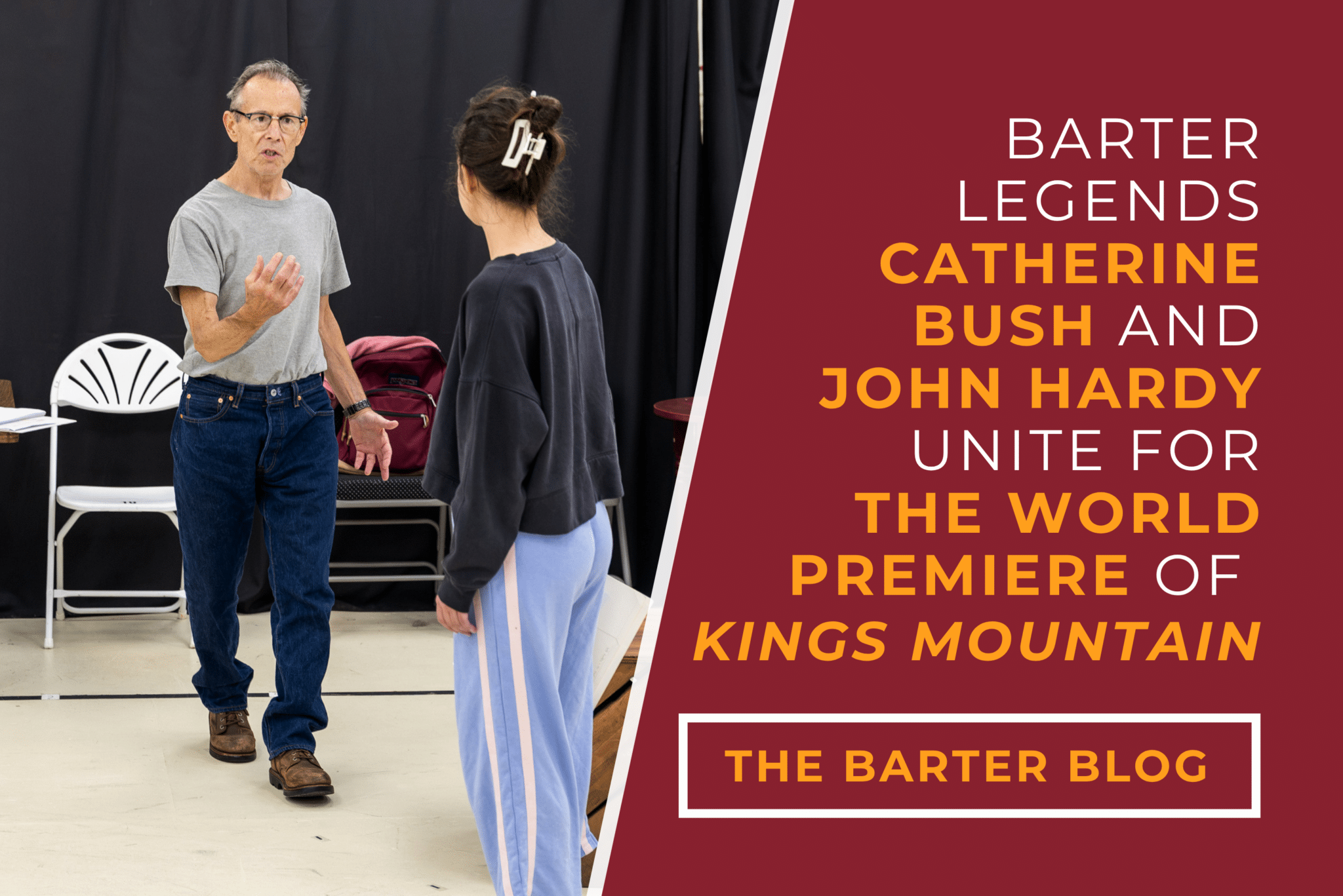
If you’re familiar with Barter Theatre, you know Catherine Bush and John Hardy. Perhaps not in name or appearance, but certainly in talent. Cathy serves as Barter’s Playwright-in-Residence, while John has juggled multiple roles throughout his time here, from founding The Barter Players to directing and training the next generation, all while continuing to grace the stage himself. This dynamic duo has worked on a total of 24 productions together, dating all the way back to Bush’s first play at the theatre, The Other Side of the Mountain, in 2005. This season, they’re uniting forces once more to bring the world premiere of Kings Mountain to life at Barter’s Smith Theatre.
After spending the last two decades creating alongside each other, Bush and Hardy have a seamless and unspoken ease about their collaborations. Cathy writes; John directs, dramaturges, or acts in one of her masterpieces. For Kings Mountain, he was tasked with not only directing, but dramaturging the revolutionary new work.
You might be wondering what all that entails? A dramaturg serves as a sort of advisor to the playwright, and helps refine the work, bring context, and overall assists in the creation of the story. The director acts as a visionary and is the one in charge of bringing the script to life on stage. This puts Hardy in a unique position, giving him an intimate, inside-out view of the colonial world Cathy’s script transports us to.
That inside-out perspective begins long before the actors ever step into the rehearsal room. Bush began writing Kings Mountain with what she jokingly describes as “about 45 plays” packed into one, initially weaving together both a past and present-day story. Hardy’s first major piece of advice was simple: “Keep it all in the past. Let’s just keep telling that story.” From there, they began shaping the play around the image of a spiral, with each event building on the last as the action moves faster and faster toward the battle. Structuring the story also meant juggling dozens of characters with only a handful of actors. “Everybody’s doubling up [on roles],” Bush explained, so the order of scenes sometimes had to allow an actor to transform from one historical figure into another. From there, Bush and Hardy worked through the script “line by line,” identifying where there was too much, too little, or something simply wasn’t working.
With the logistical aspects covered, the next challenge the two creatives faced was historical accuracy. Created in partnership with the Virginia American Revolution 250 Commission, the production spans roughly seven years, beginning with James Boone’s death in 1773 and tracing the events that led up to the tide-turning and often forgotten Battle of Kings Mountain in 1780. The script includes several larger-than-life historical figures like George Washington, John Sevier, and even the mythical Daniel Boone. One of the biggest questions in the creation process was how much artistic liberty can we take with the lives and actions of these real-life people to serve the story?
For Bush, the answer lies between what history tells us and what it leaves unsaid. “When you’re dealing with history, you have to stay within the parameters of it,” she explained. But those parameters still leave room for imagination. For example, did General Cornwallis and King George III have the conversation seen in Kings Mountain? “I have no idea,” Bush admitted. But as Hardy would ask, “Could it have happened?” If the answer is yes, the possibility becomes another doorway into the world of the play.
That same artistic freedom allows Bush to give a voice to people history too often overlooks. “I wanted to make a real effort that the whole story was told versus…just the victor’s version of it.” To do that, she created characters like Aunt Sally, an enslaved Black woman who brings the history of the Cherokee people and their land into the story, while also shedding light on the perspectives of women, British soldiers, Loyalists, and others whose experiences are often absent from traditional accounts of the Revolution. “I try to get as many points of view as possible,” Bush explained. By widening that lens, Kings Mountain becomes not only about the people who fought in the war, but about all those who lived through it.
At the heart of those experiences is a story deeply rooted in Appalachia. When British Major Patrick Ferguson threatened the frontier communities of the Overmountain Men, these militiamen gathered at sites including Abingdon’s historic Muster Grounds, crossed the mountains, and helped change the entire course of the Revolutionary War. Nearly 250 years later, Kings Mountain brings their story to the stage, shining a well-deserved spotlight on the role our region played in shaping a nation.
Special thanks to Nancy Arnold, Spectrum Design, and The United Company for making this production possible. Designated a VA250 Signature Event, Kings Mountain is playing September 17 through October 31 at Barter’s Smith Theatre. Throughout the run, the Barter Lounge will also feature a free companion exhibit exploring the people, events, and history that inspired the play, giving visitors another way to experience the story of Kings Mountain.
